

Integrative Dentistry & Precision Medicine · Miraflores, Oeiras (Lisbon)
Biological implant dentistry
Metal-free implants, placed within a biological approach led by Dr. Miguel Stanley.
since 1999
caring for patients in Miraflores, Oeiras
1200+
zirconia implants placed by our team
99%
success rate in our own clinical records
The metal-free option
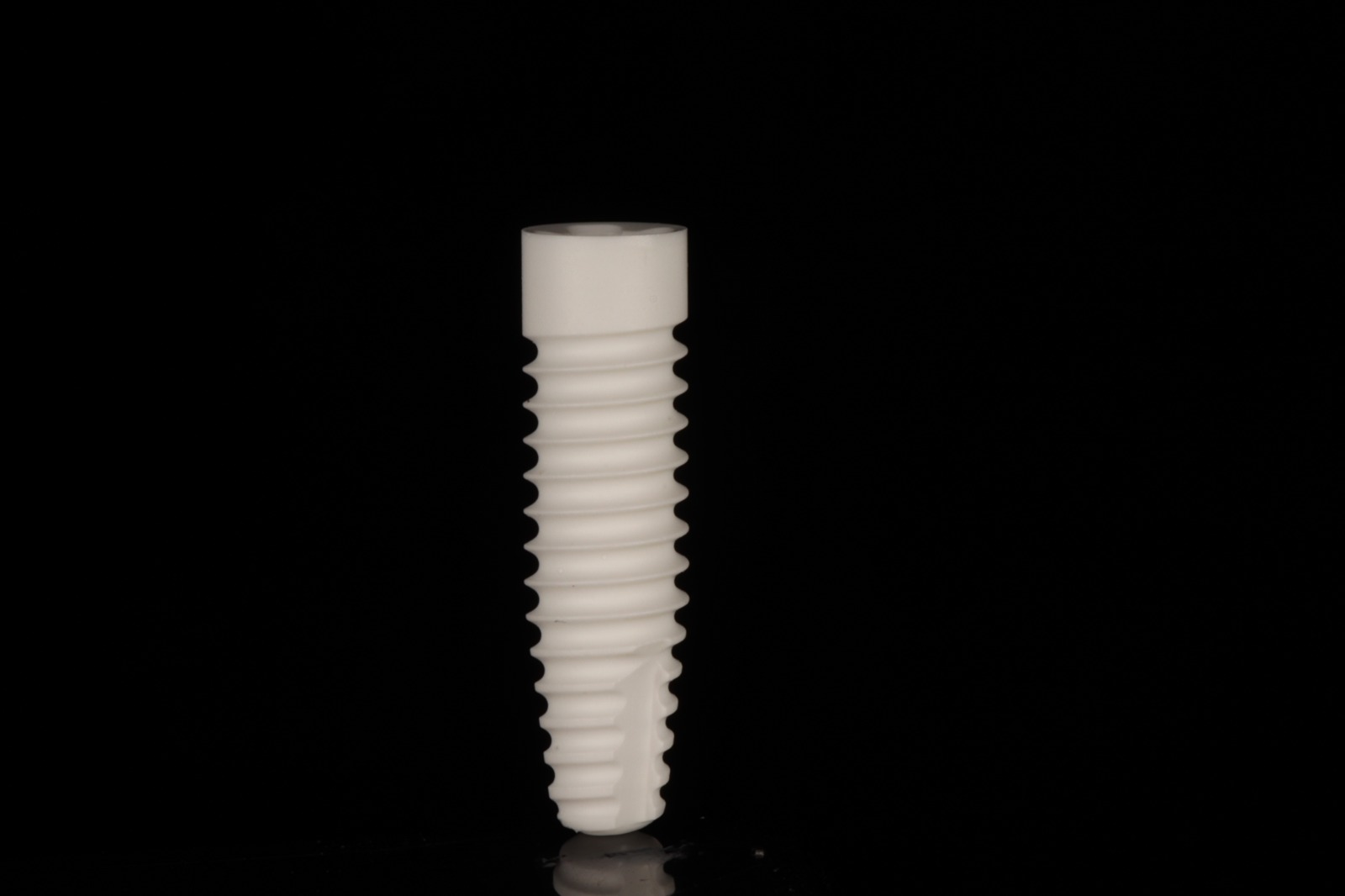
A dental implant is an artificial tooth root, placed in the jawbone to support a replacement tooth. Most implants are made of titanium. A zirconia implant does the same job, but it is made of zirconia, a high-strength ceramic, so the implant itself contains no metal.
Once the implant has integrated with the bone, typically over two to six months, a custom-made crown is attached to restore the form and function of the missing tooth.
New to dental implants? Start with our guide to implant dentistry.

Swiss-made and certified
The zirconia implants we use are Swiss-made and hold CleanImplant certification, an independent seal confirming that the implant surface is free of contamination. This matters because independent analyses have found manufacturing residues and particulate contaminants on some commercially available implants, even when they meet conventional sterility standards, and these may influence the early inflammatory response and osseointegration.
Surface cleanliness is one of the criteria behind every implant system we select. Dr. Miguel Stanley is an ambassador of the CleanImplant Foundation and a member of its Honorary Board.
Our team has placed more than 1200 zirconia implants, with a success rate of around 99% in our own clinical records. That is above the averages reported in the published literature: a 2023 systematic review and meta-analysis of clinical studies found a 10-year cumulative survival rate of 95.1% for zirconia implants.
Why metal-free
For patients with a documented sensitivity to metal, or who prefer a metal-free solution, zirconia offers a ceramic alternative to titanium.
Zirconia is white, close to the colour of a natural tooth root.
When the clinical picture justifies it, we test for metal hypersensitivity before the implant material is chosen.

Our philosophy
Biological dentistry looks at the mouth as part of the whole body. At White Clinic, every treatment plan starts from that connection between oral health and general health, and the choice of materials is part of it.
That is why many of our patients ask for metal-free options such as ceramic implants.
Because true healing starts where everything connects: in the mouth.

Founder and clinical director
Dr. Miguel Stanley founded White Clinic in 1999 and, as Clinical Director, leads every clinical decision. He has given over 300 lectures in 50 countries on implantology, prosthodontics and complex oral surgery, and keeps up around 100 hours of continuing education a year.

CleanImplant Foundation
Dr. Miguel Stanley is an ambassador of the CleanImplant Foundation, the independent organisation that tests dental implants for surface contamination, and sits on its Honorary Board. It is the same standard we apply when choosing the implants we place.
One team, one lab
Behind every implant is a team of around 40 people. Oral surgeons, periodontists, prosthodontists, dentists, oral hygienists and lab technicians plan and review each case together, from the first scan to the final crown. Our medical team works in the same clinic, so blood tests and medical history are read alongside the dental findings, not in a separate report.
This is the team behind more than 1200 zirconia implants. Our in-house lab designs every crown digitally and finishes it by hand, so we can start work on a case straight away, with full quality control over every stage of the treatment plan.

Your treatment
The plan follows the diagnosis, not a fixed package. Biology sets the surgical calendar, not the other way round.
01
A full clinical assessment with a CBCT 3D scan and a review of your medical history, to understand whether a zirconia implant is right for you.
02
Inflammation and healing capacity are addressed before surgery, not after. Depending on your case, this may include blood tests such as vitamin D, an aMMP-8 saliva test and metal hypersensitivity testing.
03
Each implant is planned digitally from your CBCT scan and placed with a 3D-printed surgical guide, our default protocol for every surgical case since 2014.
04
Recovery follows its own protocol, with adjunct therapies such as photobiomodulation when indicated. Your final crown is made in our in-house lab.
Our protocols
Before any surgery, we look at the conditions your body brings to it. Depending on your case, this can include blood tests, most often vitamin D, which plays a part in bone metabolism and the immune response, and inflammatory markers, requested and interpreted by our medical team.
An aMMP-8 saliva test shows whether gum tissue breakdown is active at the time of the test, which matters before an implant is placed. Any inflammation is treated first, so that it is resolved before surgery, not discovered after.
Metal hypersensitivity is a delayed immune reaction. It is rare, but documented in a small subgroup of patients, for example those with inflammation that has no other apparent cause or an implant failure that has not been explained.
When the clinical picture justifies it, we carry out metal hypersensitivity testing before the implant material is chosen. It is a selective diagnostic tool, not a routine screen, and it does not mean that titanium is unsafe.
Every implant is planned digitally from a CBCT 3D scan, which we have used since 2007. The position, angle and depth of each implant are defined in the digital plan and transferred to surgery with a 3D-printed surgical guide, instead of being estimated during the operation.
Guided surgery has been our default protocol for every surgical case since 2014, not an option reserved for complex cases.
During implant surgery at White Clinic, you are never in the hands of one person alone. A full surgical team is present: two attending dentists, a nurse and a dental assistant. Intravenous (IV) support and pain management are part of the surgical protocol.
As the founding clinic of the Slow Dentistry Global Network, we follow mandatory disinfection steps between patients and limit each surgery room to eight appointments a day.
During surgery, we use Er:YAG laser and ozone, together with PRF (platelet-rich fibrin), a concentrate prepared from a small sample of your own blood.
Each surgery is closed with carefully selected, high-quality surgical sutures.
Recovery begins in the surgery room. Immediately after the procedure, the post-operative protocol includes photobiomodulation, which we introduced in Portugal in 2015, together with cryotherapy and hyperbaric oxygen therapy.
Alongside medication and follow-up visits, these therapies complement post-operative care and never replace it.
Global dental care
Through our Global Dental Care service, your case can be assessed remotely from the scans you send us, so you receive a plan and an estimate before you travel, and treatment is concentrated into as few trips as possible. The final plan always depends on the in-person assessment.
Patient reviews
Read what patients from Portugal and abroad say about their treatment at White Clinic.
FAQ
An artificial tooth root made of zirconia, a metal-free ceramic, placed in the jawbone to replace the root of a missing tooth. After osseointegration, the process in which the bone integrates with the implant surface, typically over two to six months, a crown, bridge or prosthesis is attached.
Titanium is the material with the largest body of clinical evidence, with well-documented osseointegration and long-term survival rates. Zirconia is a metal-free ceramic with more recent long-term evidence, considered for patients with a documented sensitivity to metal or who choose a metal-free solution. At White Clinic, the choice follows the clinical assessment and the CBCT scan, including bone volume and the position of the tooth being replaced.
It is rare, but documented. Metal hypersensitivity is a delayed immune reaction described in a small subgroup of patients. It does not mean that titanium is toxic or that implants tend to fail. That is why we do not test every patient: metal hypersensitivity testing is a selective diagnostic tool, used when the clinical picture justifies it. When hypersensitivity is documented, zirconia implants can be an alternative, while long-term comparative data continue to evolve.
Most adults can be, but some conditions need careful consideration or treatment first: active gum disease, insufficient bone volume, heavy smoking, uncontrolled diabetes, bisphosphonates or other anti-resorptive medication, and previous radiotherapy to the area. The assessment includes a CBCT scan and a review of your medical history, and may include blood tests.
No duration can be guaranteed. The literature describes high survival rates at 10 years, and many implants remain functional for decades when placed well and maintained. Longevity depends on oral hygiene, regular maintenance visits, control of risk factors such as smoking and diabetes, and the absence of peri-implantitis. The crown on the implant is subject to wear and may need repair or replacement over time.
Every treatment plan is personalised, so the cost depends on your case. You receive your plan and its estimate after your first consultation.
Tell us about your case and our team at White Clinic in Miraflores, Oeiras (Lisbon) will get back to you.